Clay Soils - planting and lawns
December 13 2020
Clay soils, which also manifest themselves as “hard lawns” are not inherently bad, they have many nutrients locked up in them that roots can access.
They however spend nearly all the year desiccated (hard) or saturated. There is only two short periods during which is can be worked. Before it gets too desiccated or too saturated.
The structure of clay soil can be easily damaged when saturated by walking on it
The adding of grit or sand to improve it cannot be practically undertaken due to the quantity required.
Organic matter is the best way of improving the soil, by digging in peat free compost and/or leaf matter. This can be boosted by adding Soil Biology, through deep soil air probes that adds habitats (zeolites) for microbes, packed with Soil Biology. This method will also create fissures in the soil to aid drainage and add aeration..
In addition we can drench with Soil Biology to boost microbial activity and the plants, trees and lawns.
Soil Biology (specifically Mycorrhizal Fungi) extend in effect the root system of grass, plants and trees by up to 700 times. This makes them stronger and more resilient.
When planting in clay soils, there are plants and trees that are suited to heavier soils.
Plants and trees are grown in relatively light soils, then when planted in dense clay soils, problems can occur. Moisture in the dense clay soil wicks accross into the lighter root ball soils, filling the planting pit up like a sink and drowning most plants.
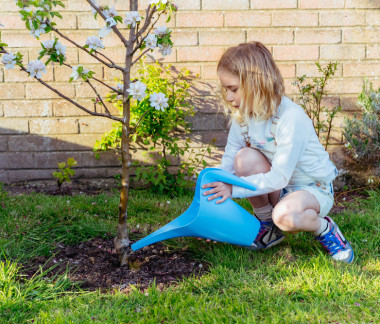
To alleviate this, do not dig a larger pit, it will just create a larger sink to fill up. Plant the specimen, slightly raised, so that some of the roots can always breathe. Then bench soil up around the exposed root system.
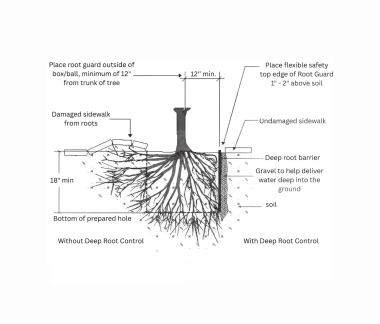
If you can drain the planting pit somewhere, do so with a length of land drainage pipe or French drain, from near the bottom of the planting pit.
There is little point in installing a gravel layer, unless it drains somewhere.
Add Soil Biology and mulch then top up the mulch every year. This will slowly add organic matter to the soil.
With hard lawns, we can add Soil Biology, to help. Ideally mowing is undertaken with a mulching mower (or cut twice weekly without collecting). This will feed the soil biology as it composts down. Please think of grass cuttings as valuable organic matter that should be retained within your garden.
Call us on 01277 849990
or request a call back
Please note that in most cases we can provide a outline quotation by telephone, that will be confirmed during a site visit.