The challenges in transplanting large trees
February 17 2026
The transplanting of large trees is often seen as an acceptable compromise between development ambition and environmental responsibility. In practice, however, relocating established trees is one of the most complex and high-risk interventions in the built environment. Success is governed not by good intentions alone, but by biological limits, logistical realities, long lead times, significant cost and sustained aftercare. When any of these factors are underestimated or overlooked, failure is not just possible, it is likely, writes Aaron Morley at Ruskins, the tree transplanting and soil specialists.
Understanding the challenges involved is essential for anyone considering tree transplantation as part of a development or landscape strategy. Large trees are living systems, not interchangeable assets and success depends as much on planning and patience as it does on execution.
One of the most significant constraints in transplanting large trees is timing. Tree movement is governed by biological cycles, not construction programmes. The optimal season for transplanting in the UK runs from October through to March, when trees are dormant and their water demand is low. Attempting to move trees outside this window dramatically increases stress and mortality risk. Trees that are able to be transplanted with Tree Spades can be relatively easily transplanted using specialist machines during these months.
For larger trees, timing becomes even more complex. Root pruning, which is essential to encourage a compact, fibrous root system capable of surviving relocation, must be carried out well in advance. In many cases, this means intervention one to two years before the tree is due to be moved. This long lead time is often incompatible with fast-moving development schedules, particularly where tree relocation is considered late in the planning process.
Without sufficient advance preparation, even the most carefully executed transplant can fail, not because of poor workmanship, but because the tree simply has not had time to adapt.
The budget reality
Cost is another major challenge and one that is frequently misunderstood. Transplanting trees using Tree Spades is often more cost-effective than purchasing and planting new trees of equivalent size. However, this equation changes rapidly as tree size increases.
Larger trees require greater preparation, specialist equipment, extended site time and significantly more aftercare. The financial commitment does not end once the tree is replanted. These tree transplants require intensive monitoring and maintenance for many years, sometimes eight years or more, before they can be considered fully established.
This means that the budget for aftercare has to be known when transplanting is being considered, especially with the larger trees - because without competent monitoring and aftercare, the outcomes for the transplanted trees are not favourable. However, the
addition of a water supply to facilitate automated irrigation can dramatically reduce costs, when competently monitored.
Furthermore, where a tree is moved to is just as important as how it is moved. Transplanting within the same site is by far the most effective and economical option. When trees need to be transported over distance, complexity and cost can increase significantly.
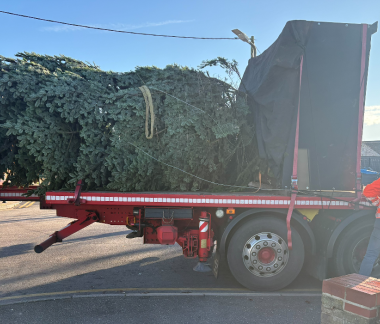
Moving trees beyond the immediate site usually requires rootballing rather than spade lifting, introducing additional handling, lifting equipment and transport considerations. For larger specimens, the sheer size and weight of the rootball can make use of the public road network impractical or impossible. In these cases, retaining trees within the site boundary becomes not just preferable, but often the only realistic option.
Logistical constraints can also limit access for machinery. Tree Spade operations require space, not just around the tree itself, but for the vehicles involved. Restricted access, tight working zones or competing site activities can quickly rule out transplantation, regardless of the tree’s ecological value.
Soil conditions and root behaviour
Soil type also plays a critical, but often overlooked role in determining transplant viability. Trees growing in light, sandy soils or areas with thin topsoil tend to develop wide, spreading root systems as they search for water and nutrients. While this adaptation supports survival in poor conditions, it creates significant challenges when transplantation is attempted.
Wide, shallow root systems are difficult to capture within a manageable rootball. Even with careful preparation, a larger proportion of the tree’s functional roots may be lost during lifting. This increases transplant shock and extends recovery time, placing greater reliance on aftercare and increasing the risk of failure.
In contrast, trees growing in deeper, more cohesive soils are often better candidates for relocation, as their roots are more compact and easier to retain. Understanding these differences early can prevent costly attempts to move trees that are biologically ill-suited to transplantation.
As we have demonstrated, transplanting large trees demands space, both above and below ground. For Tree Spade operations, access is required for up to a three-axle rigid six-wheel-drive vehicle, along with sufficient clearance to manoeuvre and operate safely. Larger trees require even greater working areas around the rootball, which can conflict with buildings, services, boundary treatments or retained structures.
On constrained sites, these spatial requirements can quickly become prohibitive. Underground utilities, foundations and hard landscaping can further restrict options, reducing the number of viable transplant locations and increasing the likelihood that retention in situ is the most responsible outcome, where possible.
The Importance of Aftercare
However, perhaps the most underestimated challenge of transplanting large trees is aftercare. Moving a tree inevitably reduces its root system, limiting its ability to absorb water and nutrients. Recovery is not automatic and cannot be left to chance.
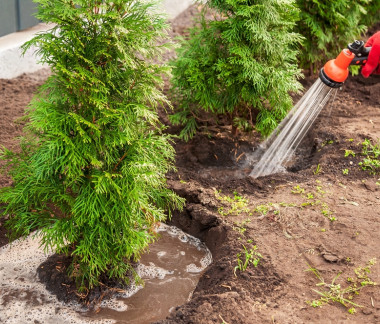
Without consistent, competent monitoring and maintenance, transplanted trees are unlikely to survive, regardless of how carefully the move itself was executed. Watering is the most critical requirement, but not the only one. Soil condition, mulching, pest monitoring and structural stability all play a role in helping a tree re-establish.
Aftercare must be planned, funded and managed over multiple years, not months. This long-term commitment is essential to allow the root system to regenerate and eventually return to its original functional capacity. Where this commitment cannot be guaranteed, transplanting becomes an exercise in false economy.
Transplanting large trees can deliver significant environmental and visual benefits, but it is not a universal solution. Success depends on early planning, realistic budgets, suitable soil conditions, appropriate access and above all, a long-term approach to aftercare.
Too often, transplantation is treated as a last-minute compromise rather than a strategic decision. When undertaken without sufficient time, space or resources, the risks outweigh the benefits. Conversely, when properly planned and supported, large tree transplantation can preserve valuable landscape assets and deliver meaningful ecological continuity.
The challenge lies in recognising that trees operate on biological timescales, not construction programmes. Respecting those limits is not a constraint, but a prerequisite for success.
Call us on 01277 849990
or request a call back
Please note that in most cases we can provide a outline quotation by telephone, that will be confirmed during a site visit.