What is the difference between tree removal and tree translocation?
November 12 2026
Tree removal involves felling a tree, dealing with the stump and disposing of the resulting material. The tree's stored carbon and habitat value are lost from that location and replacement planting usually begins with much smaller specimens.
Tree translocation, also known as tree moving or tree transplanting, involves lifting a tree with an appropriately prepared root ball and replanting it in another location. This might be elsewhere on the same site, in a temporary holding area during construction (on/off-site) or at an agreed off-site location.
Ruskins has specialised in tree moving since 1986 and operates a fleet of specialist tree spades for moving trees in a range of settings. With more than 40 years of experience, we know that with suitable preparation and aftercare, translocation can preserve a tree's size, much of its existing carbon store and its contribution to the landscape.
The key distinction is that removal is a process of taking a tree out, whereas translocation is a planned engineering and horticultural operation. It needs to be considered alongside the masterplan, construction programme and landscape design rather than added as an afterthought.
When is tree removal the right decision?
Tree translocation is not suitable for every tree. In some circumstances, removal is the more practical and responsible option. A tree that is dead, dying or structurally unsafe may not be suitable for relocation. Trees classified as Category U under BS 5837:2012 are generally considered unsuitable for retention because of their condition or limited remaining contribution.
The quality and species of the tree also matter. A low-quality specimen with limited landscape value may not justify the cost and effort involved in moving it. Some species, particularly those with root systems that make successful transplanting more difficult, can also present greater challenges at certain sizes.
Space is another important consideration. If the completed development offers no suitable location for the tree and an appropriate off-site destination cannot be secured, translocation may not be viable.
Finally, where the planning authority has accepted the tree's removal and agreed a suitable replacement planting scheme, the case for relocation may be less compelling. Even then, it is worth considering whether retaining the tree could offer additional landscape, carbon or biodiversity benefits.
A specialist assessment can help establish which trees are realistic candidates for moving and which are better dealt with through removal and replacement.
When should developers consider tree translocation?
Translocation becomes particularly valuable when a tree has benefits that would be difficult to recreate through new planting.
Trees classified as Category A or B under BS 5837 are generally of higher or moderate quality and may be important to the planning and landscape strategy. Retaining them can help preserve the character of a site and support the development's wider environmental objectives.
A Tree Preservation Order (TPO) or conservation area designation can also influence the decision. Moving a protected tree requires the appropriate consent from the local planning authority, just as removal does. Translocation should not be assumed to be automatically permitted, but it can provide an alternative worth exploring where retaining the tree is important.
Sometimes, the tree itself is not incompatible with the development - it is only in the way during construction. A tree that obstructs a road, crane position or temporary working area may be moved into a suitable holding area and reinstated when construction is complete.
Biodiversity and carbon objectives can provide further reasons to investigate relocation. Large trees provide established habitat and store carbon accumulated over many years. Replacement planting can contribute to future environmental value, but it does not immediately recreate what has been lost.
Translocation may also help deliver a more established landscape from the outset. Moving an existing specimen can be an alternative to buying and planting a comparable large tree, although the relative cost will depend on the tree, the site and the method required.
Tree removal or tree translocation: five questions to ask
Before deciding what to do with existing trees, developers should consider five practical questions.
1. What is the tree's condition and quality?
Start with the arboricultural survey. Its assessment, including the relevant BS 5837 category, helps establish whether the tree is suitable for retention and whether moving it is worth investigating.
2. Is the tree protected or important to the planning application?
Check for a TPO, conservation area status and any specific planning requirements. Discuss potential relocation with the local planning authority and project arboriculturist before committing to a course of action.
3. Does the tree conflict with the finished development or only with the construction works?
If the tree has a place in the completed landscape, but obstructs temporary access or construction activities, moving it and reinstating it later may be a practical solution.
4. What are the biodiversity and carbon implications?
Consider the existing tree's contribution, the value of the habitat and the time required for replacement planting to establish. Where biodiversity net gain (BNG) is relevant, agree the treatment of a translocated tree with the project's ecologist rather than assuming it will receive the same credit as a retained tree.
5. What is the whole-life cost?
Compare the cost of removal and stump treatment with the costs of relocation, aftercare and any required replacement planting. Include the potential implications of planning delays, redesign and the need to establish a new landscape.
The decision should be made as early as possible, ideally while the tree survey and masterplan are still being developed. This gives the design team more opportunity to identify suitable destinations and plan the work around the construction programme.
Most sites will require a combination of approaches. Some trees may need to be removed, others can be retained in place and selected specimens may be suitable for translocation. The same principle can apply to established hedgerows, where sections can sometimes be moved using specialist equipment and appropriate preparation.
How are large trees moved?
The method depends on the tree's size, species, condition, root system and the conditions on site.
Tree spades for smaller trees
A tree spade uses curved blades to cut around a tree's root system, forming a root ball that can be lifted and transported to its new position. This approach is particularly useful for smaller trees and can make relocation a fast, repeatable operation. Trees with trunk diameters of around 20cm may be suitable for tree-spade relocation, although suitability depends on the individual tree and the equipment available.
Ruskins operates specialist tree-spade equipment, including the Stocker 8, which has a 2.16m spade. The company's specialists can assess whether a particular tree can be moved using this method.
Root ball, frame and crane for larger trees
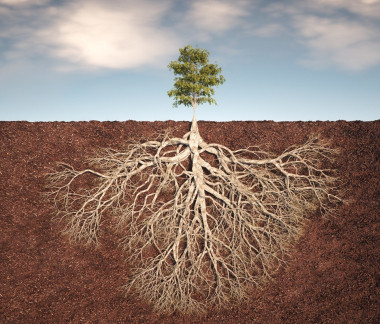
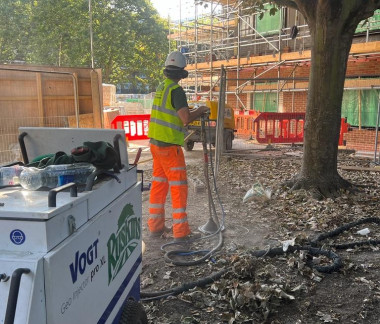
Larger trees may require a more involved process. Root preparation can include using compressed air with an Air Spade to expose roots and help prepare the root system. The root ball is then secured within a suitable frame before the tree is lifted by crane.
Ruskins has undertaken specialist moves involving root balls weighing more than 100 tonnes. Such operations require careful planning, suitable lifting equipment and an assessment of ground conditions, access and the receiving location.
Temporary storage and reinstatement
On a constrained development site, it may not be possible to return a tree to its permanent location until construction is complete. In these circumstances, a suitable temporary holding area can be used, provided the tree can be maintained and monitored.
The tree is then reinstated when the finished landscape is ready. This approach can help developers retain valuable trees without compromising the construction sequence, but the storage location, watering regime and duration must be planned carefully.
Why aftercare matters
Moving a tree is only part of the process. Its long-term prospects depend on root preparation, planting conditions, watering and ongoing care.
Construction activity can leave soil compacted, limiting the air and water available to roots. Appropriate soil preparation, including decompaction and soil biology treatments, may form part of the aftercare plan where site conditions justify them.
The receiving location must be suitable for the tree's needs and watering and monitoring are particularly important during establishment. A specialist should specify the aftercare required for the individual tree and site.

Call us on 01277 849990
or request a call back
Please note that in most cases we can provide a outline quotation by telephone, that will be confirmed during a site visit.