Why a play tree does not tell a child how to play
September 09 2026
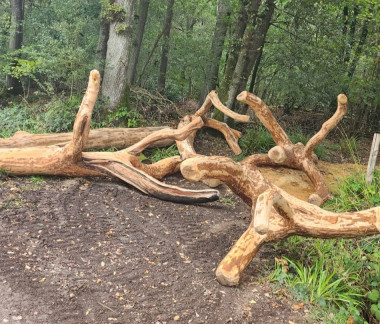
A Play Tree can become a bridge, a mountain, a den, a spaceship or part of an adventure that exists only in a child's imagination and that freedom may be one of its greatest strengths. This is an important consideration when creating outdoor spaces because the best natural play features leave something for children to work out for themselves, where the child decides what happens next writes Joana Lideike, at Ruskins, the soil and tree specialists.
A systematic review published in US magazine PLOS ONE examined 16 studies involving children aged two to 12 and found that unstructured nature play using features such as Play Trees, had consistent positive effects on physical activity and cognitive play behaviours, including imaginative and dramatic play.
The review concluded that this was because a Play Tree has no prescribed storyline. It can be climbed, balanced on, walked around or incorporated into a game invented by the children using it. A Play Log might become an obstacle, a bridge or the boundary of an imaginary world. A Balance Beam creates a physical challenge, but the child decides how to approach it. That open-ended quality gives children opportunities to make decisions, solve problems and create their own rules.
Learning happens through doing
These challenges also develop physical skills while encouraging concentration, judgement and an awareness of personal ability. This is where managed risk becomes valuable. Children are given the opportunity to test themselves, recognise a challenge and decide how they want to approach it.
A further review published in International Journal of Environmental Research and Public Health, covering 21 studies of risky outdoor play, found positive associations with physical activity and social health. The researchers also made an important distinction between manageable risks that children can recognise and assess and hazards they cannot reasonably judge for themselves.
A Play Tree, Play Log or Balance Beam therefore offers more than a physical activity. It creates a situation where children make choices, test their abilities and learn from the outcome.
The objective is not to make play dangerous. It is to create environments where children can encounter appropriate challenges within a properly considered setting. That experience can help children understand what they can do, when they need to take care and when they are ready to try something new, but there is much more.
Timber has texture. Bark has a pattern. It is tactile, people will without think touch it. Children are therefore interacting with something that feels connected to the natural world rather than an object with one predetermined function.
The latest Children's People and Nature Survey, published by Natural England in 2025, found that 93% of children and young people aged 8 to 15 agreed that being in nature makes them very happy. The survey was based on responses from 3,993 children and young people across term-time and school-holiday periods. That is a striking indication of the relationship children have with natural environments and a Play Tree provides one way of bringing that experience directly into a designed play space.
Confidence grows through small challenges
There is, of course, a difference between telling a child they can do something and allowing them to discover it themselves. Reaching the other side of a log after several attempts is a small achievement. Balancing for a little longer, climbing a little higher or working out how to get around an obstacle provides another.
Open-ended play also creates opportunities for children to negotiate with each other. One child may decide that the Play Tree is a pirate ship while another thinks it is a mountain. They have to agree on the rules, decide who does what and adapt their ideas as the game develops. A natural play feature therefore becomes a meeting point as much as a physical structure.
For landscape designers and developers, this changes the question around what a play space should contain. A feature does not need to have one obvious purpose to be successful. In many cases, its value lies in how many different possibilities it creates.
A Play Tree can support climbing, balancing, storytelling, exploration and group play. A Play Log can become an obstacle, a seat, a bridge or part of a game. A Balance Beam can offer a challenge that changes as a child becomes more confident. The feature provides the opportunity. The child provides the imagination and that is the hidden value of natural play.
This is because the best play environments do not tell children exactly what to do - they give them something to discover.
Call us on 01277 849990
or request a call back
Please note that in most cases we can provide a outline quotation by telephone, that will be confirmed during a site visit.