Blending nature with adventure in modern landscapes
May 15 2026
There is something instinctive about the way people respond to natural landscapes. You see it time and again. Given the choice between a manufactured play structure and a fallen tree trunk, most people - children and adults alike - will gravitate towards the tree. It is not always logical and it is rarely planned, but it is consistent, writes Aaron Morley at Ruskins, the tree and soil specialists.
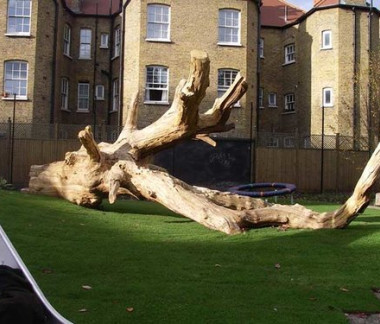
At Ruskins, we see this first-hand through the use of Play Trees, Play Logs and natural boulders within developments. These are not elaborate installations. They are simple, honest elements drawn from nature. Yet they consistently outperform more engineered features when it comes to engagement.
What is particularly striking is how people interact with them. Children don’t need instructions or signage. They climb, balance, jump and explore instinctively. But it is not just children. Adults do exactly the same, often without realising it. There is a moment, usually brief, but unmistakable, where something changes. A kind of playfulness takes over. We often describe it as the “inner monkey” emerging, usually accompanied by a slightly mischievous, Cheshire Cat grin.
We have seen this across countless sites, but one example stands out. An 80-year-old lady, who had previously run an adventure playground, came across a Play Tree. Within moments, she had climbed onto it and was walking along the trunk with complete confidence. It was not staged, and it was not unusual. It was simply a reminder that the instinct to engage with natural forms does not disappear with age.
Why natural play works
Modern landscapes often prioritise control. Surfaces are even, edges are defined and activities are structured. While there is a place for this, it does not always encourage exploration or imagination.
Natural features, by contrast, are unpredictable. A tree trunk may twist, a log may vary in height, a boulder may present multiple routes to climb. These small variations create opportunities for movement, balance and problem-solving in a way that feels intuitive rather than imposed.
This is not just anecdotal. Research from the National Trust has shown that children who engage with natural play environments demonstrate higher levels of creativity, confidence and physical activity. The lack of prescription encourages them to test their limits and develop their own ways of interacting with the space.
But perhaps more importantly, it feels different. There is a sensory richness to natural materials that cannot easily be replicated. The texture of bark, the solidity of stone, the irregularity of a surface underfoot - these are experiences that connect people to their surroundings in a more direct way.
In recent years, there has been growing awareness of the relationship between access to nature and mental wellbeing. This is not simply about aesthetics or visual appeal. It is about how people feel within a space.
The Mental Health Foundation has reported that spending time in natural environments can reduce stress, improve mood and enhance overall wellbeing. Even relatively short periods of interaction with nature have been shown to have a positive impact.
What is interesting about natural play elements is that they encourage this interaction in a very immediate way. They are not something to be observed from a distance. They invite participation.
Climbing a log, balancing on a tree trunk or sitting on a boulder may seem like small actions, but they create moments of engagement that are both physical and mental. They draw attention away from everyday pressures and towards the present moment. In a sense, they create a form of informal mindfulness, without the need for instruction or intention.
This applies just as much to adults as it does to children. In fact, adults often benefit most from these moments, precisely because they are unexpected. A quick pause on a log, a spontaneous climb, or even just the act of sitting on a natural feature rather than a bench can change perspective, even if only briefly.
A different kind of landscape
For developers and designers, the inclusion of natural play elements represents a different way of thinking about landscape design. It is not about replacing all man-made features, but about rebalancing the environment.
Too often, landscapes are designed to be looked at rather than used. Grass is laid, planting is installed and spaces are defined, but opportunities for interaction are limited.
By introducing elements such as Play Trees, Play Logs and boulders, landscapes become more dynamic. They encourage movement, exploration and social interaction. They create informal gathering points and moments of discovery.
Importantly, they also age well. Unlike manufactured equipment, which can date or require replacement, natural features tend to integrate more fully into their surroundings over time. They weather, settle and become part of the landscape rather than sitting apart from it.
There is also a social dimension to consider. Natural play elements often bring people together in ways that more structured environments do not.
A log becomes a place to sit, balance or chat. A cluster of boulders becomes an informal meeting point. These are not designated spaces, but they function as such because of how people choose to use them.
In this way, natural features can help foster a sense of community. They create shared experiences, however small, that contribute to how people relate to a place and to each other.
Perhaps the most compelling aspect of natural play is that it requires no explanation. There are no instructions, no rules and no expectations. People simply respond. This instinctive interaction is what makes it so powerful. It taps into something fundamental, something that exists regardless of age, background or environment.
In a world that is increasingly structured and digital, these moments of unplanned, physical engagement are becoming more valuable. They offer a counterbalance to the pace and complexity of modern life.
A practical approach
From a delivery perspective, incorporating natural play elements is often simpler than it might appear. It does not require complex infrastructure or significant additional cost. What it does require is an understanding of how these elements can be selected, positioned and integrated effectively.
At Ruskins, our role is to help shape these spaces in a way that feels natural and intuitive. This means working with the landscape, rather than imposing upon it. It means selecting materials that are appropriate to the setting and ensuring they are installed safely and sustainably.
Blending nature with adventure is not about creating something new. It is about rediscovering something that has always been there. People are drawn to natural forms in ways that are difficult to replicate with manufactured solutions. They climb, balance, explore and engage, often without thinking. In doing so, they experience moments of connection, both with the environment and with themselves.
Whether it is a child testing their balance, an adult rediscovering a sense of play, or an 80-year-old walking along a tree trunk with a smile on her face, the impact is the same. Nature invites participation and when we design spaces that allow for that, everything changes.
Call us on 01277 849990
or request a call back
Please note that in most cases we can provide a outline quotation by telephone, that will be confirmed during a site visit.