Rethinking the Christmas Tree with a more sustainable solution for councils and businesses
February 20 2026
In the UK alone, an estimated 7 to 8 million real Christmas trees are purchased each year, according to the British Christmas Tree Growers Association. However responsibly they are recycled, the reality remains the same - most are grown to be cut, displayed briefly and disposed of. While most of these have been used in homes across the country, it is a different story for larger trees used by businesses and local authorities which face sustainability targets, carbon reduction strategies and ESG commitments. For them, this annual cycle of use and discard is increasingly difficult to justify, when there is a less environmentally damaging alternative.
At a time when Companies and Councils are being asked to think long-term about resources, waste and environmental impact, one Essex-based business is challenging the throwaway tradition with a far more sustainable alternative.
Ruskins, long established as tree and soil specialists, has developed a growing service that rethinks how larger Christmas trees are supplied to towns, city centres, corporate headquarters and public spaces. Instead of cutting and replacing trees year after year, Ruskins cultivates and cares for them at its premises in Essex, transporting them across the country for the festive season and then returning them to continue growing once Christmas has passed. It is, in essence, a circular approach to what has traditionally been a disposable feature.
For local authorities, businesses and large organisations, the appeal is practical as well as environmental. The demand for prominent Christmas trees has not diminished - if anything, expectations have risen. Communities want impressive, well-lit focal points that bring people together during December. But increasingly they also want those displays to reflect responsible environmental stewardship.
A larger tree that is grown, maintained and reused over decades tells a very different story from one that is felled, transported, displayed and then chipped within a matter of weeks.
Start planning now
Ruskins’ approach begins long before December. Trees are selected, nurtured and shaped over many years to achieve the height, density and symmetry required for high-profile installations. Soil health, root structure and long-term vitality are managed carefully so that when the tree is transported and positioned, it is robust enough to withstand both the journey and the seasonal display.
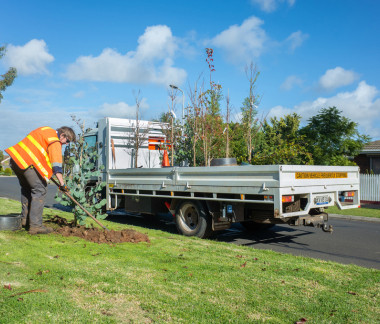
The logistics are significant. Larger trees (6-8m tall plus 1-1.5m tall container) destined for town centres or commercial properties require specialist lifting, transport and installation. They must be secured safely, positioned accurately and prepared for decoration. Yet unlike traditional cut trees, these retain their root systems and continue their life cycle once the festivities are over.
When January arrives and decorations come down, the trees are not consigned to waste. They are collected and returned to Ruskins’ facilities, where they are monitored, fed, pruned and protected throughout the year. In time, they return to the same location or are rotated to another site, often becoming familiar seasonal landmarks.
For corporate estates and councils, teams under pressure to demonstrate measurable sustainability improvements, this offers a visible and credible initiative. Carbon reduction strategies increasingly scrutinise supply chains and lifecycle impacts. While Christmas trees may seem minor compared with infrastructure or transport emissions, symbolic gestures matter - particularly when they are repeated annually.
Although the upfront cost of a managed, living tree may differ from purchasing a cut alternative each year, the long-term model can offer predictability. Instead of sourcing, selecting and transporting a new tree annually – with all the uncertainty around size, shape and condition – organisations work with a known, established asset.
Community asset
For communities, there is also something reassuring about continuity. A tree that returns year after year becomes part of a place’s identity. People see the same tree return illuminated each December. It anchors memories rather than being a throwaway festive gesture.
Ruskins’ broader expertise in soil management and arboriculture underpins the credibility of the service. The company’s background means the trees are not simply stored between uses - they are actively cared for. Root systems are protected, soil conditions optimised and health assessments carried out to ensure longevity. In effect, the Christmas display becomes an extension of long-term tree stewardship, with their tree, welcomed back each year.
This approach aligns with a wider change in how public spaces are managed and companies are increasingly expected to demonstrate environmental leadership, not only in major capital projects, but also in everyday decisions. Reusable Christmas trees may seem modest in scale, but they reflect a mindset that values preservation over replacement.
Businesses, too, are reassessing festive displays. Corporate sustainability reports increasingly track resource use, waste reduction and biodiversity commitments. Choosing a living, reusable tree sends a subtle but powerful message to employees, customers and stakeholders that environmental considerations extend beyond headline initiatives.
Of course, no solution is entirely without impact. Transporting and installing large trees requires equipment and planning. But compared with the annual cycle of cultivation, felling, transport and disposal associated with single-use trees, a managed, multi-decade lifecycle represents a meaningful reduction in waste and resource consumption.
Perhaps most importantly, the model reframes the relationship between celebration and consumption. Christmas trees are symbolic - representing continuity, renewal and life in the darkest part of the year. Extending the life of those trees, rather than ending it prematurely, feels aligned with that symbolism.
In a season defined by light and renewal, it is a reminder that even the most familiar traditions can evolve - and that sometimes, the most meaningful change is simply choosing to care for what we already have.

Call us on 01277 849990
or request a call back
Please note that in most cases we can provide a outline quotation by telephone, that will be confirmed during a site visit.